Raksha Bandhan Mehndi Designs for 2026: Modern Trends, Application Chemistry, and Stain Optimization
Key Takeaways:
- 2026 Aesthetic Shift: Contemporary festival layouts emphasize negative-space wristbands, delicate bracelet cuffs, and micro-scale figurative motifs over dense forearm coverage.
- Paste Chemistry: Formulating pure Lawsonia inermis with high-terpene monoterpene alcohols ensures dye release yields exceeding 2.2% lawsone concentration.
- Stain Oxidation: Achieving a deep burgundy stain requires a non-aqueous 24-hour sealing window followed by 48 hours of progressive atmospheric oxidation.
Applying henna for festive occasions requires balancing speed, comfort, and visual impact. Whether preparing for family gatherings or executing client appointments, selecting the right composition ensures the design looks intentional and holds up against holiday wear.
This technical guide breaks down the defining motifs of raksha bandhan/rakhi mehndi, the molecular dynamics of dye release, and application strategies to ensure crisp line definition and rich color development.
Raksha Bandhan Mehndi 2026: Evolution of Tradition and Technique
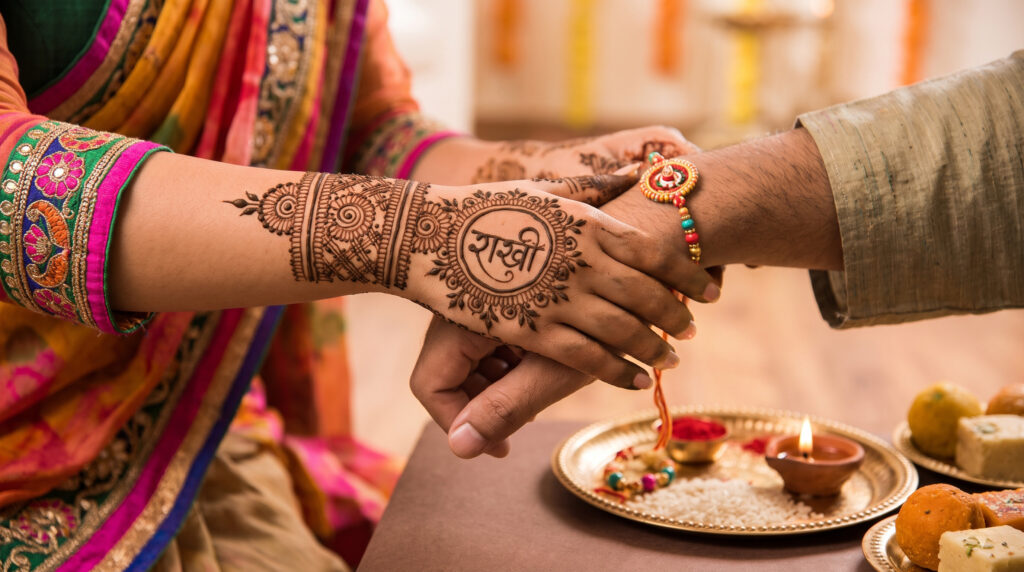
The cultural practice of tying a protective thread (rakhi) onto a sibling’s wrist creates a unique design canvas. Unlike extensive bridal compositions that cover the full forearm and palms, festival applications require deliberate negative space around the wrist joint to allow bracelets to rest comfortably without friction.
Over recent seasons, henna artists have shifted away from congested traditional layouts toward architectural spacing. The 2026 festival cycle prioritizes high-contrast focal points, geometric mandala rosettes, and fine linework that mimic permanent jewelry. Because family festivities involve food preparation, sweets handling, and gift exchanges, fast-drying, smudge-resistant layouts take precedence over sprawling, full-arm coverage.
Using fresh, sifted Lawsonia inermis powder ensures sharp drape lines and uniform paste extrusion. Understanding these structural demands helps both hobbyists and experienced artists execute designs that harmonize with modern festive attire.
What Are the Primary Raksha Bandhan Mehndi Trends for 2026?
Quick Answer: Raksha Bandhan mehndi in 2026 focuses on minimalist negative-space cuffs, micro-detail brother-sister storytelling silhouettes, and geometric mandala bracelets. Artists achieve peak color intensity by pairing high-lawsone organic Rajasthani henna with cajeput or eucalyptus terpenes, yielding rich mahogany stains that mature over a forty-eight-hour oxidation window for festival celebrations.
Contemporary compositions balance heritage elements with minimalist visual architecture. The three primary design pillars for the 2026 festival cycle include:
- Jewelry-Inspired Cuffs: Mimicking stacked bangles and intricate filigree chains, these patterns encircle the distal forearm while leaving the central palm open.
- Negative-Space Radial Mandalas: Central motifs built with reverse-fill shading create bold visual impact using half the paste volume of traditional fills.
- Micro-Silhouette Storytelling: Minimalist silhouettes illustrating sibling rituals replace large portrait compositions, requiring ultra-fine nozzle precision.
Core Architectural Styles: Motif Selection and Composition
Designing a successful festival layout demands conscious planning of negative space, scale, and dermal placement.
[ Distal Forearm ] -> Geometric Lattice / Reverse-Fill Cuff | [ Wrist Joint ] -> Negative Space Void (Friction Relief for Thread) | [ Dorsal/Palm ] -> Central Radial Mandala or Micro-Figurative Focal Point | [ Phalanges ] -> Ring-Style Bands with Exposed Distal Knuckles
Negative Space and Minimalist Wristbands
Leaving bare skin around the wrist joint prevents the physical rakhi thread from abrading wet paste or fading fresh stains. Symmetrical bands featuring reverse vines, dot clusters, and clean teardrop chains provide an elegant aesthetic without overcrowding the hand. For those booking festive looks, reviewing curated mehndi services and portfolios can guide the right balance of coverage and detail.
Storytelling Motifs and Sacred Iconography
Micro-portraits capture traditional festive gestures—such as tying the sacred thread, offering sweets (mithai), or presenting the prayer plate (aarti thali). Execute these elements with continuous 0.3mm to 0.4mm lines. Framing central figures with geometric arches prevents the figurative art from blending into surrounding filler elements.
Henna Chemistry and Paste Formulation: Maximizing Lawsone Yield
Rich color development depends on liberating the lawsone molecule (2-hydroxy-1,4-naphthoquinone) from the dried plant cell walls. Once released, lawsone bonds with the keratin protein found in epidermal cells.
- Lawsonia inermis powder + Mild Acid (pH 5.2 – 5.8)
- Cleaves Aglycone Precursor Molecules Add Terpenes (Cajeput / Niaouli)
- Promotes Lawsone Transdermal Dispersion 24-Hour Oxidation
- Hennotannic Acid Intermolecular Cross-Linking
Monoterpene alcohols containing high concentrations of terpineol loosen the pigment molecules, accelerating absorption through the stratum corneum.
Formulation Matrix for High-Yield Paste
| Ingredient | Standard Ratio | Functional Role | Operational Parameter |
|---|---|---|---|
| Sifted Henna Powder (Rajasthani Sojat) | 100 g | Substrate source of lawsone pigment | Sifted through 100-mesh silk fabric |
| Acidic Diluent (Lemon Juice or Water) | 220–240 ml | Lowers pH to trigger steady dye release | Target pH 5.4 to 5.7 |
| Essential Oil (Cajeput or Tea Tree) | 30 ml | High-terpene solvent for pigment suspension | Contains minimum 60% terpineol |
| Caster / Dextrose Sugar | 20–30 g | Humectant; controls paste flexibility | Adjust down in humid climates |
For a smooth consistency, sift dry powder twice to eliminate plant residue that could clog fine cones. Rest the prepared paste at 24°C (75°F) for 8 to 12 hours until the surface turns brown, indicating active dye release.
Step-by-Step Technical Application Protocol for High-Definition Lines
Flawless linework requires steady paste viscosity, proper cone grip, and disciplined pressure control.
1. Dermal Preparation
Cleanse the hands and arms with isopropyl alcohol or witch hazel to strip natural sebum and cosmetic lotions. Never apply mineral oil or heavy moisturizers before application, as synthetic barriers prevent the lawsone dye from penetrating outer skin layers.
2. Applicator Calibration
Use hand-rolled cellophane or 20-micron BOPP cones cut to a precise 0.35mm opening. A calibrated nozzle opening delivers uniform line weights without trailing edges.
3. Structural Drape Dynamics
Extrude lines by draping the henna strand over the skin surface rather than dragging the cone tip along the epidermis. Keep the cone tip elevated 2mm above the skin, guiding the paste through downward gravitational tension.
- Correct: Cone Tip elevated [2mm] —> Henna drapes cleanly via surface tension
- Incorrect: Cone Tip touching skin —> Leaves jagged edges, uneven line weight
4. Non-Aqueous Sealant Application
Once paste sets to the touch (approx. 20 minutes post-application), apply a boiled solution of 50% white granulated sugar and 50% strained lemon juice using a light cotton dabber. If living in humid regions, replace sticky sugar-lemon sealants with breathable medical retention tape (such as Mefix) to preserve fine linework.
Real-World Benchmarks: Stain Development Timeline and Oxidation Profile
Henna stains progress through distinct physiological phases as the pigment reacts with ambient oxygen and binds to keratinocyte protein structures.
[ Paste Removal: Hour 0 ] -> Bright Pumpkin Orange (Surface Dye Penetration) | [ Oxidation Phase: Hour 24 ] -> Warm Auburn / Deep Chestnut | [ Peak Saturation: Hour 48 ] -> Deep Mahogany / Near-Black Undertone | [ Exfoliation Phase: Day 8+ ] -> Natural Keratin Desquamation and Fading
Temporal Oxidation Metrics
| Phase | Elapsed Time | Chromatic Output | Biochemical Mechanism |
|---|---|---|---|
| Unsealing | 0 Hours | Neon Tangerine | Lawsone molecules sit unbound in epidermal pores |
| Initial Bond | 6–12 Hours | Rust Orange | Moisture exposure is avoided; atmospheric oxidation begins |
| Polymerization | 24–36 Hours | Deep Auburn | Pigment links with keratin through trans-oxidation |
| Peak Maturity | 48 Hours | Rich Mahogany / Burgundy | Full hennotannic saturation in stratum corneum |
To ensure peak color for Raksha Bandhan festivities, schedule application 48 hours prior to the main family ceremony. Explore our dedicated mehndi aftercare guide for comprehensive tips on protecting your design against early fading.
Troubleshooting Edge Cases: Skin Porosity, Temperature, and Stain Failures
Cold Extremities and Vasoconstriction
Low body temperature restricts peripheral blood flow, reducing the rate of dye absorption. If a client has cold hands, warm the skin using a heating pad or clove steam (laung dhuni) before and after application to encourage pore absorption.
Rapid Desiccation in Air-Conditioned Spaces
Dry indoor air causes paste to crack and detach before dye release completes. Add 5 grams of additional sugar per 100 grams of dry powder during dry seasons, or seal dried paste with hypafix tape to lock in warmth and natural perspiration.
Accidental Water Contact
If water contacts the skin during the initial 12-hour setting window, pat the area dry immediately with a clean microfiber cloth. Coat the exposed area with a pure botanical balming agent—such as unrefined shea butter, cocoa butter, or coconut oil—to prevent cellular wash-out.
Frequently Asked Questions
How many days before Raksha Bandhan should I apply mehndi?
Apply henna 40 to 48 hours prior to the festival. Henna stains emerge from the paste as a bright pumpkin orange and need two full days of atmospheric oxidation to reach deep mahogany maturity.
How do I prevent the rakhi thread from smudging my fresh design?
Design a 1.5-inch negative-space void around the distal wrist joint, or apply breathable medical tape over the dry stain before tying the rakhi thread to eliminate surface friction.
What is the best way to remove dry mehndi paste without washing?
Scrape dried paste off using a butter knife edge, wooden spatula, or credit card edge, then massage coconut or mustard oil over the skin to lift residual flakes. Avoid water contact for at least 12 hours.
Can I use store-bought instant red or black cones for festive designs?
Avoid commercially produced ‘instant’ cones. These formulations rely on toxic industrial adulterants, including PPD (p-phenylenediamine) and sodium picramate, which cause chemical burns and contact dermatitis. Use only certified natural henna paste.