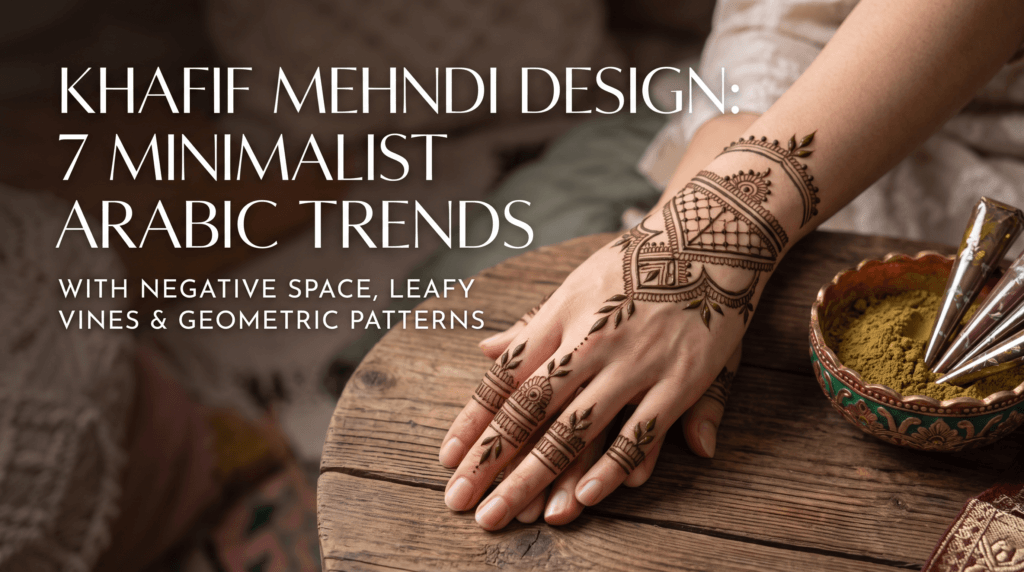
Khafif Mehndi Design: 7 Minimalist Arabic Trends with Negative Space, Leafy Vines & Geometric Patterns
Khafif mehndi design is the quiet trend reshaping how modern brides and guests think about henna. If you’ve been scrolling through mehndi inspiration lately, you’ve probably noticed hands aren’t disappearing under dense, wrist-to-elbow coverage anymore – they’re framed by open skin, thin confident lines, and patterns that breathe.
At Mehndisanskar, we’ve watched requests for Khafif mehndi design grow steadily through 2026 – from Jaipur brides wanting a lighter look for their sangeet, to Alwar clients booking this style purely for the aesthetic. In this guide, we break down the 7 defining elements of Khafif mehndi design, why it’s trending, and how to know if it’s right for your next event.
Table of Contents
- What Does “Khafif” Actually Mean?
- The 7 Signature Elements of Khafif Mehndi Design
- Why Minimalist Arabic Mehndi Is Trending in 2026
- Who Should Choose a Khafif Design?
- Khafif vs. Traditional Bridal Mehndi: How to Choose
- Caring for Fine-Line, Organic Mehndi
- Frequently Asked Questions
- Ready to Try a Khafif Design?
What Does “Khafif” Actually Mean?
Khafif is an Arabic word meaning “light” or “subtle” – and it describes this design philosophy perfectly. As Wikipedia’s overview of henna notes, “Bridal Mehndi” across South Asia and the Middle East has grown increasingly complex over time, with recent innovation specifically in fine-line work – which is exactly the technical foundation Khafif mehndi design is built on. Unlike traditional Arabic mehndi, which often uses bold, thick strokes and dense floral clusters running up the arm, a Khafif mehndi design strips the pattern back to its essentials.
Where classic Arabic mehndi says “abundance,” a Khafif mehndi design says “intention.” Every vine, every leaf, every geometric line earns its place on the hand.
The 7 Signature Elements of Khafif Mehndi Design
1. Negative Space as the Core Design Element
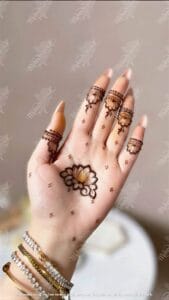
In traditional mehndi, empty skin is often treated as unfinished space waiting to be filled. In a Khafif mehndi design, negative space is the design. Bare skin isn’t a gap – it’s used the way a designer uses white space in a logo: to give the pattern room to be read clearly and let the hand itself remain visible underneath the art. This is what gives Khafif mehndi design its signature airy, “floating” look.
2. Fine-Line Technique
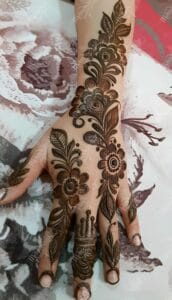
This style lives and dies by precision. Fine-line work uses a much finer cone tip and a slower, more controlled hand than bold Arabic patterns – the lines are often a third the width of traditional strokes. There’s nowhere to hide an unsteady hand in a Khafif mehndi design, because there’s no dense clustering to visually cover a wobble. This is exactly why we treat fine-line Arabic work as a specialized skill within our Arabic and Indo-Arabic design offerings.
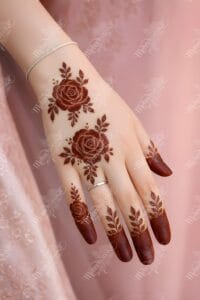
3. Leafy Vine Motifs
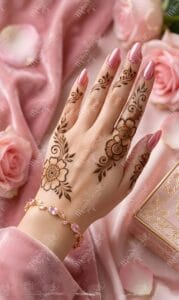
Single, trailing botanical lines mimic the organic movement of a climbing plant, often running along the side of the hand, wrist, or up a single finger. They feel natural rather than symmetrical, which is part of the charm of any well-executed Khafif mehndi design.
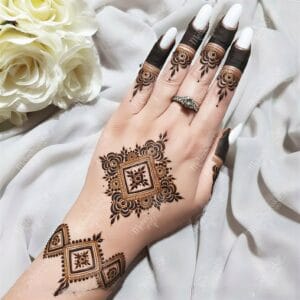
4. Geometric Pattern Accents
Clean dots, triangles, chevrons, and linear grids are used sparingly as accents or borders. Geometric elements bring structure to balance the organic softness of the vines – a hallmark of Khafif mehndi design for clients who want a modern, jewelry-inspired look rather than a traditional floral one.
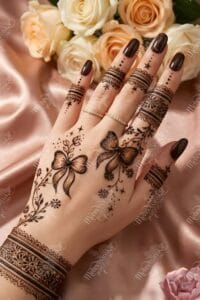
5. Wrist Vine Bracelets
A single trailing leaf-and-vine line circles the wrist, left completely open above and below – one of the most requested placements for a Khafif mehndi design at engagement functions.
6. Single-Finger Trails
A delicate geometric or floral line runs the length of one or two fingers only, leaving the rest of the hand bare – a minimal, quick-to-apply take on Khafif mehndi design that still photographs beautifully.
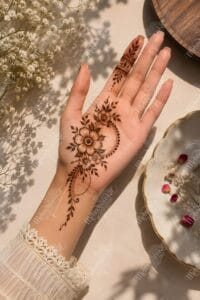
7. Geometric Cuffs & Open-Palm Centerpieces
A thin band of triangles or linear patterns worn like a mehndi cuff at the wrist, or a single small motif placed in the center of an otherwise bare palm – striking specifically because of what’s not there. Both are increasingly popular finishing touches for a Khafif mehndi design.
Why Minimalist Arabic Mehndi Is Trending in 2026
A few real shifts are driving demand for Khafif mehndi design, and they’re worth understanding if you’re deciding between a bold look and a minimalist one:
- Multi-event weddings mean multiple mehndi looks. With Rajasthani weddings often spanning an engagement, haldi, sangeet, and the main mehndi ceremony, brides increasingly want a Khafif mehndi design for earlier functions and save full bridal coverage for the big day.
- Working professionals want mehndi that transitions to office life. A delicate wrist vine reads elegant at a wedding and understated at work the following Monday.
- Photography favors negative space. Close-up ring shots and candid hand photography look more striking with open skin framing a delicate pattern than a hand fully covered in henna.
- It suits shorter events better. A Khafif mehndi design typically takes far less application time than a full bridal design, ideal for engagement parties, baby showers, Karwa Chauth, or festive family gatherings.
Who Should Choose a Khafif Design?
Minimalist Arabic mehndi isn’t only for non-bridal events – a Khafif mehndi design genuinely works for a range of people and occasions:
- Brides wanting a lighter pre-wedding look for the sangeet or a smaller pre-wedding function.
- Guests and bridesmaids who want something elegant without matching bridal-level coverage.
- Anyone attending festivals like Karwa Chauth or Teej, a celebration with roots in the broader henna ceremony tradition observed across South Asian and Middle Eastern cultures.
- First-time mehndi clients who feel unsure about committing to a dense, all-over pattern.
- Grooms and men, too – our groom’s mehndi service already leans on this same philosophy, using subtle geometric bands rather than dense coverage.
Khafif vs. Traditional Bridal Mehndi: How to Choose
If you’re torn between styles, it usually comes down to three questions:
- How much time do you have? Full bridal coverage can take several hours; a Khafif mehndi design is significantly quicker.
- Is this for the main wedding day or a smaller function? Most of our brides still choose dense traditional or Rajasthani bridal patterns for the wedding day itself, and save a Khafif mehndi design for the engagement, sangeet, or post-wedding events.
- Do you want the design to be a statement or an accent? Traditional bridal mehndi is meant to be the centerpiece; a Khafif mehndi design is meant to complement – your outfit, your jewelry, your hands themselves.
Many of our clients now book both – full bridal coverage for the wedding day and a Khafif mehndi design for an earlier function. See both styles side by side in our gallery.
Caring for Fine-Line, Organic Mehndi
Because a Khafif mehndi design uses thinner lines with less henna paste overall, a little extra care helps the color develop as richly as a bolder pattern:
- Leave the paste on for at least 4–6 hours before gently scraping it off – don’t wash it away.
- Avoid water contact for the first 12 hours to let full oxidation happen.
- Dab (don’t rub) a natural oil-sugar mix onto the design once the paste is removed to lock in moisture.
- Avoid excessive scrubbing near the design during the first two days – thin lines fade faster than thick ones if disturbed too soon.
We use 100% organic, chemical-free henna infused with eucalyptus and clove oils for every Khafif mehndi design. This matters beyond aesthetics too – the FDA’s official fact sheet on henna and “black henna” warns that additives used in some commercial “black henna” mixes can cause serious skin reactions, which is exactly why we never use them.
Frequently Asked Questions
Is a Khafif mehndi design suitable for a wedding day, or only pre-wedding events? Both work, but most brides choose a Khafif mehndi design for pre-wedding functions like the engagement or sangeet, and go with fuller traditional or Rajasthani bridal coverage for the main wedding day.
How long does a Khafif mehndi design take to apply? Typically 30–90 minutes depending on placement and complexity, compared to several hours for dense bridal coverage.
Does a Khafif mehndi design stain as dark as bolder patterns? Yes. Stain depth depends on the quality of the henna paste and aftercare, not the thickness of the line. We use the same 100% organic henna paste across every Khafif mehndi design, so it develops the same rich, mahogany stain as a full bridal design.
Can a Khafif mehndi design include a bride’s name or initials? Yes – geometric linework and fine-line technique both lend themselves well to subtly incorporating initials without breaking the minimalist look.
Do you offer Khafif mehndi design services in Jaipur, Alwar, and Dausa? Yes, we serve clients across Jaipur, Alwar, and Dausa in Rajasthan for both minimalist and traditional mehndi styles, for weddings, festivals, and personal events.
Ready to Try a Khafif Design?
Whether you want a delicate wrist vine for your sangeet or a full geometric-and-floral fusion for your wedding day, our team at Mehndisanskar specializes in both bold traditional artistry and the precision a Khafif mehndi design demands. Book an appointment with us in Jaipur, Alwar, or Dausa, or browse our gallery for more inspiration before your big day.
Have questions about which style suits your event? Call or WhatsApp us at +91 78528 82012 – we’re happy to help you plan the right design for your celebration.